Squidrouter route selection between chains
Squid is a cross-chain router that matches the requested assets and networks to available routing components. A path can combine bridges, messaging layers and token exchanges, with token support and liquidity constraining the quote.
Network and token inputs
Squid’s API identifies each end of a route separately. The token fields refer to assets on their respective networks.
| Route request field | What it identifies |
|---|---|
fromChain
|
The source network’s chain ID. |
toChain
|
The destination network’s chain ID. |
fromToken
|
The asset being sent on the source network. |
toToken
|
The asset requested on the destination network. |
The amount is a separate input, so pricing can change while these endpoints stay the same. With
quoteOnly
set to
true
, the API returns an estimated output without transaction call data. A quote alone does not submit or complete a swap.
How protocols contribute to the path
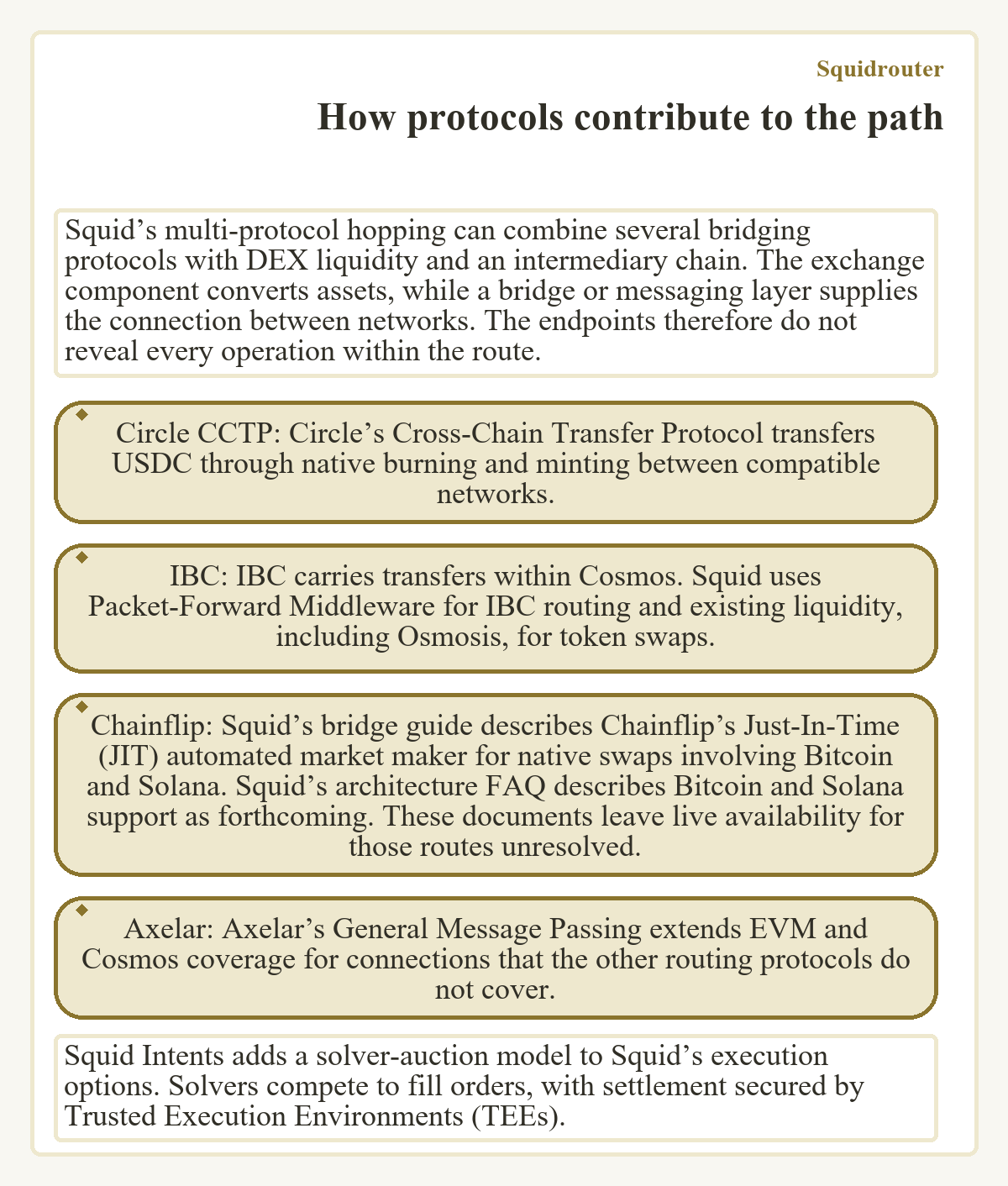
Squid’s multi-protocol hopping can combine several bridging protocols with DEX liquidity and an intermediary chain. The exchange component converts assets, while a bridge or messaging layer supplies the connection between networks. The endpoints therefore do not reveal every operation within the route.
- Circle CCTP
- Circle’s Cross-Chain Transfer Protocol transfers USDC through native burning and minting between compatible networks.
- IBC
- IBC carries transfers within Cosmos. Squid uses Packet-Forward Middleware for IBC routing and existing liquidity, including Osmosis, for token swaps.
- Chainflip
- Squid’s bridge guide describes Chainflip’s Just-In-Time (JIT) automated market maker for native swaps involving Bitcoin and Solana. Squid’s architecture FAQ describes Bitcoin and Solana support as forthcoming. These documents leave live availability for those routes unresolved.
- Axelar
- Axelar’s General Message Passing extends EVM and Cosmos coverage for connections that the other routing protocols do not cover.
Squid Intents adds a solver-auction model to Squid’s execution options. Solvers compete to fill orders, with settlement secured by Trusted Execution Environments (TEEs).
Liquidity and gas constrain the amount
For a route that exchanges tokens through a liquidity pool, the requested amount matters relative to available liquidity. A large order can trigger a price-impact warning; reducing that amount may improve the quoted price.
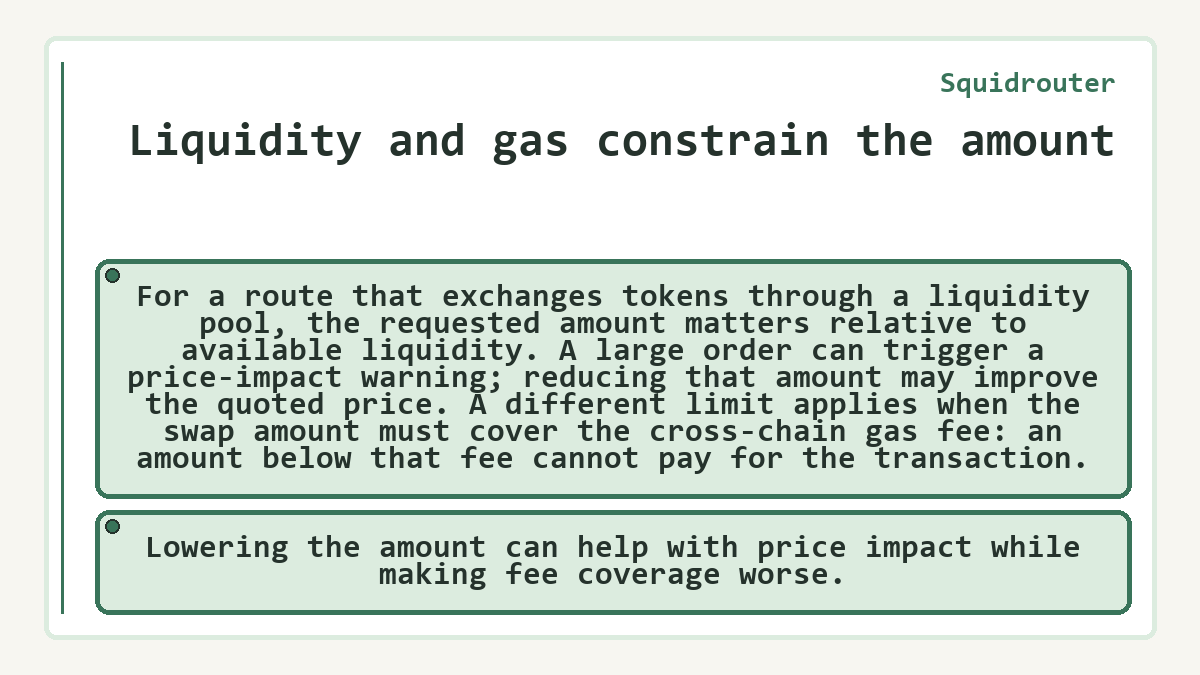
A different limit applies when the swap amount must cover the cross-chain gas fee: an amount below that fee cannot pay for the transaction. Lowering the amount can help with price impact while making fee coverage worse.
Wallet support is separate from router coverage
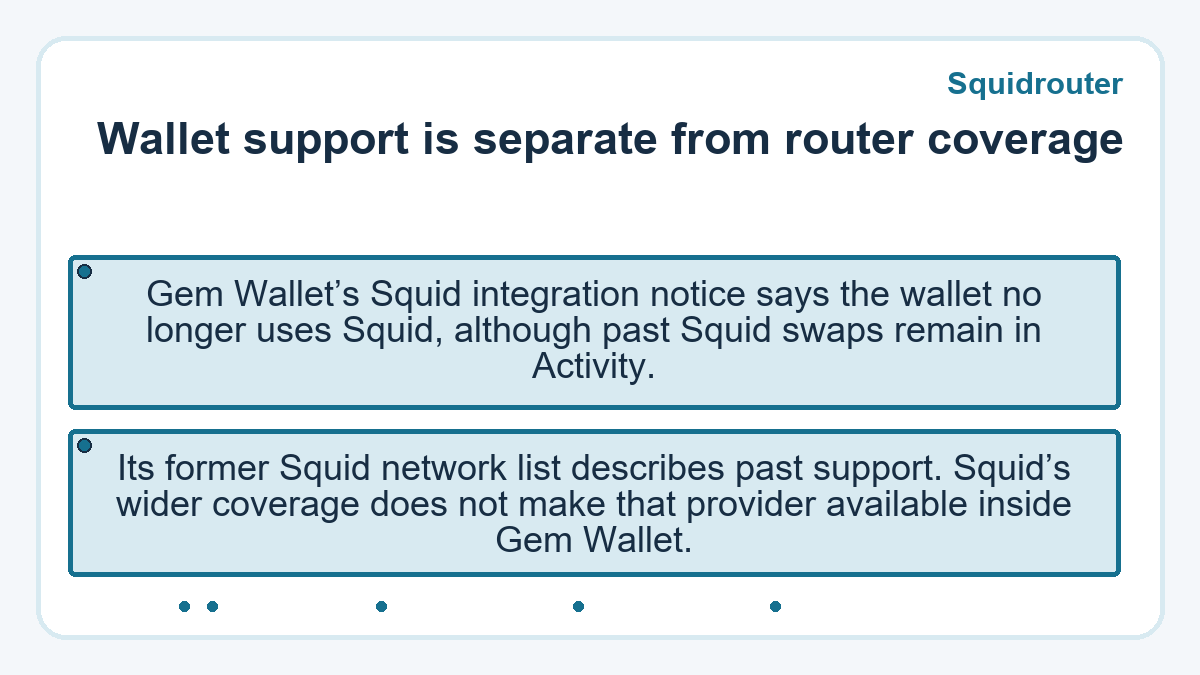
Gem Wallet’s Squid integration notice says the wallet no longer uses Squid, although past Squid swaps remain in Activity. Its former Squid network list describes past support. Squid’s wider coverage does not make that provider available inside Gem Wallet.
Updated on