Squidrouter intents: how are swaps filled and settled?
Squid Intents turns a cross-chain swap request into an order that competing solvers, also called market makers, can fill. Its auction runs after the source-chain deposit, and a Trusted Execution Environment (TEE) verifies the fill before authorizing source-chain payment to the winning solver.
Page sections
An integration needs Squid Intents enabled on its integrator ID and an available Intents route to use this settlement mechanism.
When do solvers compete?
- The user obtains a route through an enabled integration, signs and deposits on the source chain.
- Squid opens an offchain Request for Quote (RFQ) auction. Market makers compete to fill the order.
- The winning market maker fills the order on the destination chain and submits proof to the TEE.
- The TEE verifies the fill and signs the release of source-chain funds to that market maker.
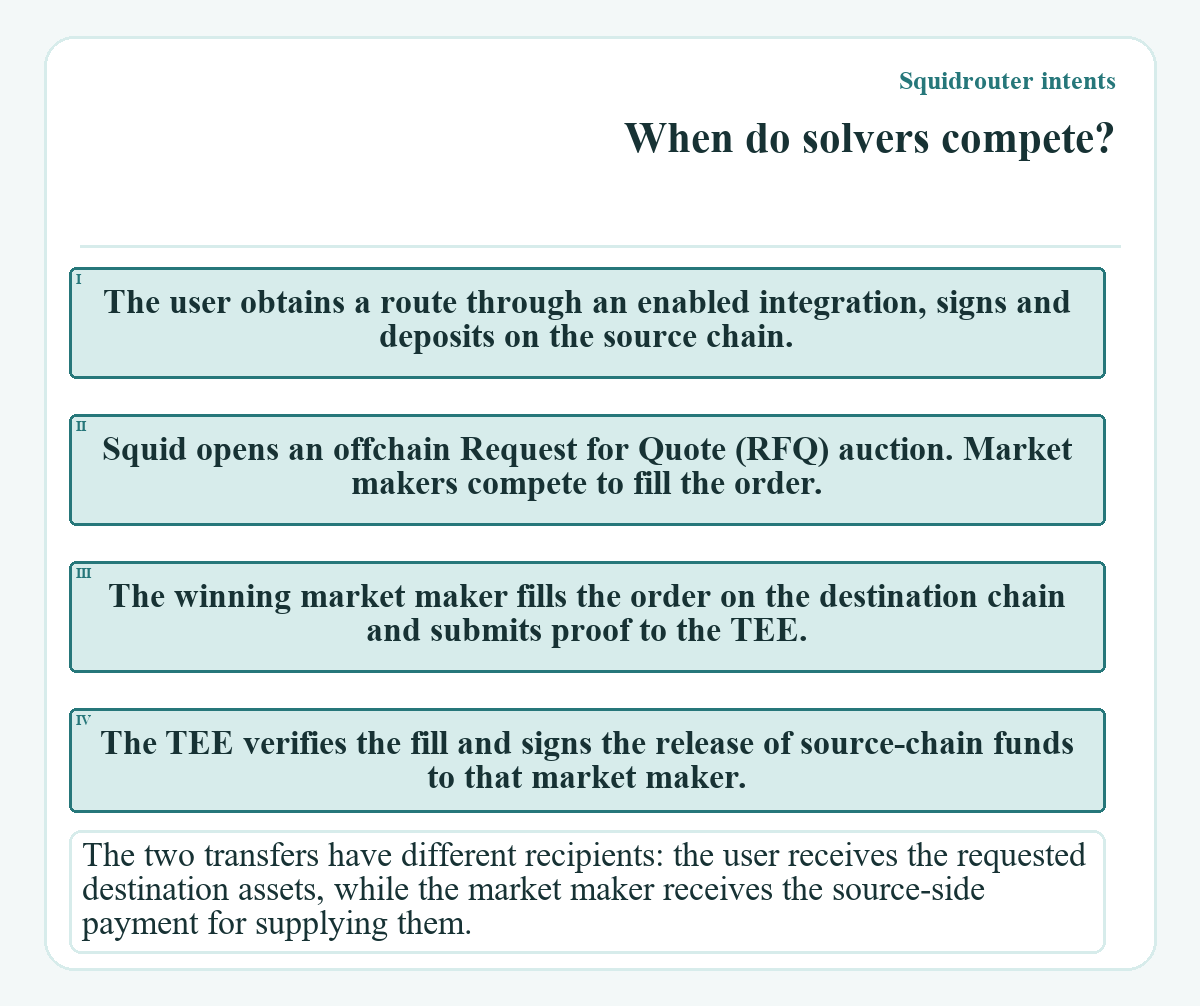
The two transfers have different recipients: the user receives the requested destination assets, while the market maker receives the source-side payment for supplying them.
What does a route without expiry mean?
Squid’s Intents documentation says routes have no submission expiry window. Its March 10, 2026 launch explanation says users receive the market price at execution without a guaranteed amount upfront; the architecture FAQ describes zero slippage at execution. A route remaining valid therefore does not, by itself, establish a fixed receive amount before the post-deposit auction.
What changed from Coral?
Coral already used solver auctions, but its settlement relied on general message passing (GMP). Squid Intents retains the auction model and replaces that settlement layer with TEEs.
A TEE runs code in a hardware-isolated environment inside a processor. Squid identifies Cubist as its TEE infrastructure provider. Verification takes place offchain, while the asset transfers remain on the participating blockchains.
Which integration requirements matter?
Squid Intents uses the shared
/v2/route
endpoint. It is not enabled by default: Squid must enable it for the integrator ID. The integration guide says an Intents route is selected automatically when the feature is enabled and a route is available. Widget integrations require
@0xsquid/widget
version
6.5.0
or newer.
After source-chain execution, the integration must poll the status API with the route’s
quoteId
. The
Integrating Squid Intents
guide states that omitting
quoteId
from status calls causes the Intents transaction to be refunded on the source chain. Obtaining a route or a source-chain transaction hash alone does not establish completed settlement.
Which costs and refunds apply?
Squid’s architecture FAQ says there is no protocol fee, while certain routes in its frontend carry a convenience fee. It describes gas for Intents as paid on the source chain. Intents also supports integrator fees, so a zero protocol fee does not imply a zero-cost swap.
For failed Intents orders, the integration guide describes automatic source-chain refunds that typically complete in approximately 15 minutes. The refund destination is
order.fromAddress
, populated from the route request’s
fromAddress
. In EVM source-chain execution, the caller that supplies the funds is
msg.sender
. That caller can be a smart contract, so the sender and refund recipient can differ.
Hypothetical refund with a contract caller
Assume a failed Intents order starts on an EVM chain, with the user’s address in the route request’s
fromAddress
and a smart contract as the source-side call’s
msg.sender
.
The resulting refund goes to the user’s address because that value became
order.fromAddress
. The contract supplied the source funds, but it is not the refund recipient in this case. This result depends on the user’s address actually being encoded as
order.fromAddress
.
Updated on